
You are now reading:
ASEAN Consumer Sentiment Study 2025 (Vietnam): Overall growth and stability drive consumer optimism
Discover how their spending and financial habits are changing with insights from UOB’s consumer confidence barometer.

Find out how we can help you fast-track your investments in the JS-SEZ.
Learn moreyou are in UOB ASEAN Insights


You are now reading:
ASEAN Consumer Sentiment Study 2025 (Vietnam): Overall growth and stability drive consumer optimism
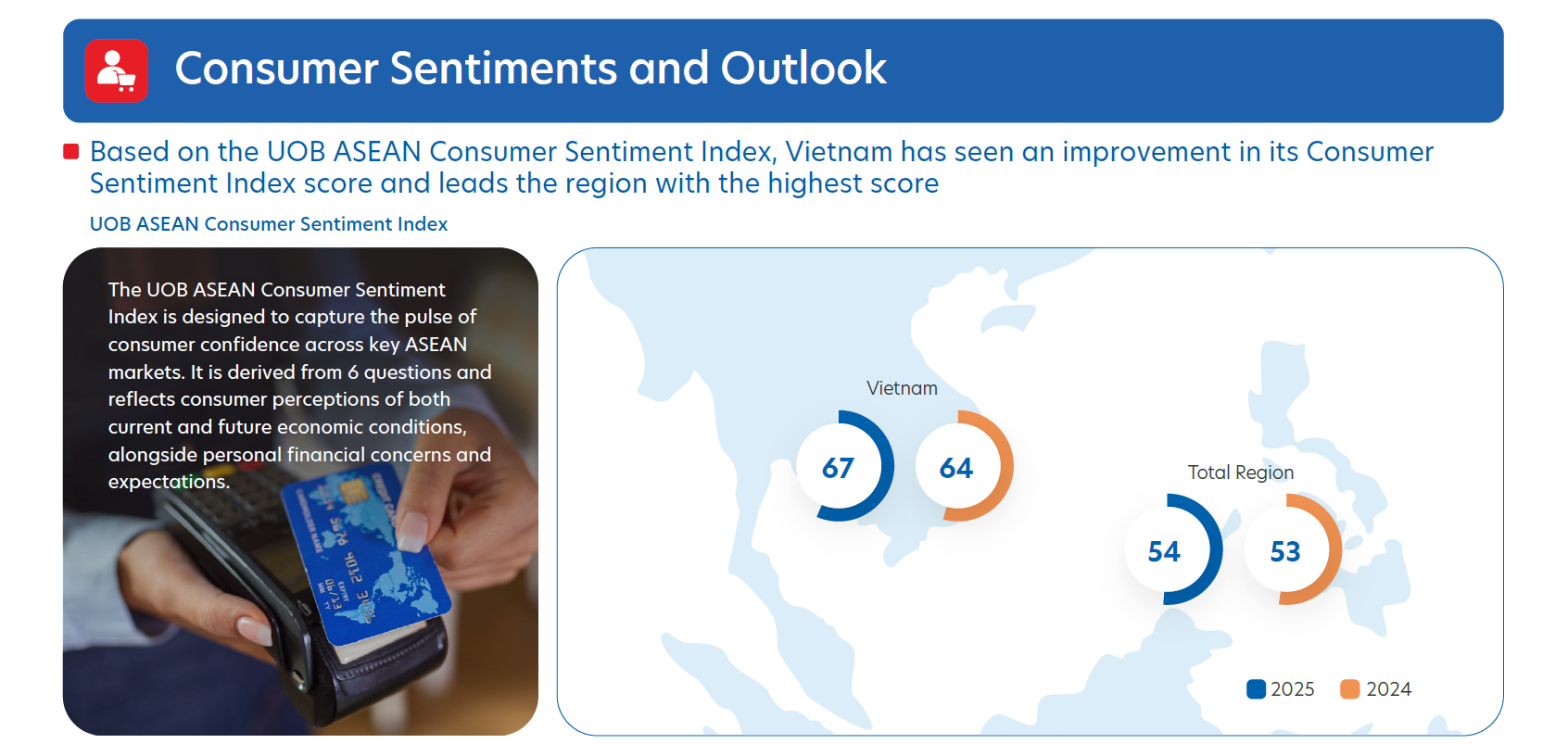
Vietnamese consumers are an optimistic bunch. Our ASEAN Consumer Sentiment Study 2025 shows Vietnam having the highest consumer confidence in ASEAN, with a sentiment score of 67 against the regional average of 54. This could be a by-product of the country’s perceived stability across economic (83 per cent), political (82 per cent), and social (81 per cent) dimensions – all significantly above regional averages.
Yet this optimism exists against a backdrop of global trade tensions, US tariffs, and economic fragmentation that have dampened sentiment in the region. What explains Vietnam's remarkable consumer confidence, and how insulated is the country from global economic headwinds?

Figure 1: Vietnamese consumers are the most optimistic in ASEAN
Before digging into the numbers, it is important to note that Vietnam is experiencing its strongest economic expansion in over a decade. The country’s GDP grew 8.23 per cent in Q3 2025, the fastest in Southeast Asia. It is forecast to grow 7.5 per cent for 2025, and has set itself a target of 10 per cent GDP growth in 2026. This represents Vietnam's fastest growth rate since 2022, placing it well ahead of regional peers.
According to the Dezan Shira and Associates’ Vietnam Briefing, wages have been growing at an annual rate of 8–10 per cent for the past few years. Furthermore, news agencies have reported a minimum wage increase of 7 per cent in 2026.
Meanwhile, the International Monetary Fund (IMF) has reported that Vietnam’s inflation has stayed steady at around 3.5 per cent for the past four years. With wage growth outpacing inflation, Vietnamese are experiencing greater purchasing power. This greatly affects consumer outlook: only 40 per cent of the population feel that inflation will impact their spending (vs 56 per cent regional). Nearly the same number (39 per cent) feel that they are getting better deals or can purchase more with what they have.
Finally, Vietnam is the primary beneficiary of global supply chain diversification away from China. Despite US tariffs, Vietnam retains its position as an investors' darling, with FDI continuing to surge even amid ongoing global tariff tensions. And manufacturing FDI doesn't just create factory jobs – it spawns entire ecosystems of logistics, services, retail, and professional employment that amplify wage growth across the economy.
Vietnamese consumers are actively participating in wealth building at rates that exceed the rest of ASEAN. About 82 per cent of Vietnamese save more than 10 per cent of monthly income – the highest in ASEAN (regional average 74 per cent). Beyond that, 85 per cent of Vietnamese report having emergency funds that cover at least one month’s living expenses.
When it comes to investing, Vietnam’s consumers also appear to be ahead of the curve. Only 3 per cent of Vietnamese report not investing at all – meaning nearly all adults surveyed have one form of financial investment. Nearly six in ten (57 per cent) invest more than 10 per cent of their annual income, which is second-highest regionally. And these are not random shots in the dark; 90 per cent of Vietnamese actively seek investment knowledge, the highest proportion in the region.

Figure 2: Vietnamese consumers are the region’s biggest savers, with 4 in 5 saving more than 10 per cent of their monthly income
Vietnamese investors are also not strangers to using financial leverage. Where only 66 per cent of regional peers might borrow money to meet their financial goals, 84 per cent of Vietnamese consumers are comfortable borrowing money for investing. This demonstrates a growth mindset rather than one bent on mere preservation: Vietnamese consumers are leveraging and investing aggressively to build their wealth.
It’s not surprising, then, that 94 per cent feel confident about managing their personal finances – again, the highest in the region.
Vietnamese consumers have the highest retirement aspirations in ASEAN – 83 per cent have at least a fair idea of retirement needs, and even among those unclear, 25 per cent are confident they'll have enough within their pension fund. The numbers reflect profound confidence in their wealth-building trajectory. Four in ten (41 per cent) Vietnamese expect to improve their lifestyle in retirement, much higher than the 15 per cent regional rate. Nearly half (47 per cent) expect to retain their current lifestyle.
In just over a decade, Vietnam has transformed from a largely cash-dependent economy to a digital-first financial system. According to a study by Cu Thi Thu Trang of Dong Do University in Hanoi, only 31 per cent of adults had bank accounts in 2014. Ten years later, 87 per cent of Vietnamese adults are banked. The steepest acceleration in banking occurred between 2021-2024, coinciding with the e-wallet boom.
This growth is reflected in Vietnamese consumers’ preference for e-wallets; 62 per cent used e-wallets in the past year, the second highest in the region. (Indonesia takes top place with 74 per cent e-wallet adoption.)

Figure 3: E-wallets have enabled financial inclusion for a large number of Vietnamese who were previously unbanked
The use of digital payments helps drive consumption, allowing users to pay for small-value goods via mobile phone accounts. E-wallets may also offer small loans directly within the app, with approvals based on wallet transaction history. This makes loans accessible to populations that previously didn’t qualify for traditional financing.
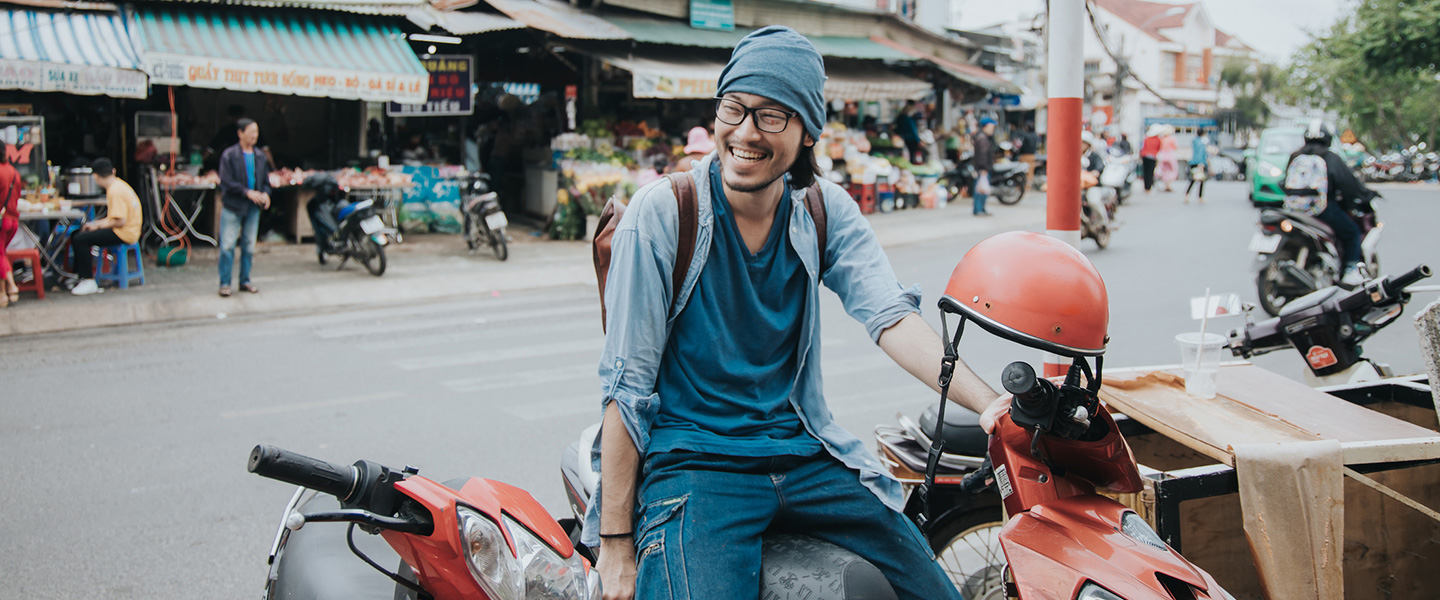
Furthermore, e-wallets democratise access. Street vendors, market stalls, and small shops can now participate in the digital economy.
Digital leapfrogging, or the early adoption of more advanced technologies due to a lack of traditional infrastructure, has reshaped Vietnam's economic landscape thanks to digital banking. This shift has directly contributed to consumer confidence, which can be attributed to greater financial access.
Vietnam's robust consumer confidence is a result of strong economic fundamentals, successful wealth-building participation, and rapid financial innovation. Understanding how Vietnam sustains its remarkable momentum – and how businesses can best engage with this optimistic, digitally-empowered consumer base – is crucial for strategic planning in 2026 and beyond.
Drawing on our extensive network and deep regional expertise across ASEAN, UOB is committed to helping businesses navigate dynamic markets and capture opportunities. Contact us to explore how we can support your strategic growth and investment goals.
Download the report and infographics to gain valuable insights, detailed data on consumer segments, and actionable strategies for navigating one of the region's most promising markets.
The ASEAN Consumer Sentiment Study (ACSS) is UOB’s regional flagship study that analyses consumer trends and sentiment across five countries (Singapore, Malaysia, Thailand, Indonesia, and Vietnam).
Now in its sixth year, the 2025 survey was conducted in June and captures responses from 5,000 consumers — 1,000 from each country. At UOB, we help businesses navigate the dynamic landscape of the ASEAN region to unlock its full potential.
Key topics covered include:
This article shall not be copied or relied upon by any person for whatever purpose. This article is given on a general basis without obligation and is strictly for information only. The information contained in this article is based on certain assumptions, information and conditions available as at the date of the article and may be subject to change at any time without notice. You should consult your own professional advisers about the issues discussed in this article. Nothing in this article constitutes accounting, legal, regulatory, tax or other advice. This article is not intended as an offer, recommendation, solicitation, or advice to purchase or sell any investment product, securities or instruments. Although reasonable care has been taken to ensure the accuracy and objectivity of the information contained in this article, UOB and its employees make no representation or warranty, whether express or implied, as to its accuracy, completeness and objectivity and accept no responsibility or liability for any error, inaccuracy, omission or any consequence or any loss or damage howsoever suffered by any person arising from any reliance on the views expressed and the information in this article.

17 Mar 2026 • 5 MINS READ

09 Dec 2025 • 5 mins read
Get the ACSS 2025 Vietnam infographics.Download now