You are now reading:
ASEAN Consumer Sentiment Study 2025 (Malaysia): Optimism for the future, anxiety in the present
Discover how their spending and financial habits are changing with insights from UOB’s consumer confidence barometer.

Find out how we can help you fast-track your investments in the JS-SEZ.
Learn moreyou are in UOB ASEAN Insights


You are now reading:
ASEAN Consumer Sentiment Study 2025 (Malaysia): Optimism for the future, anxiety in the present
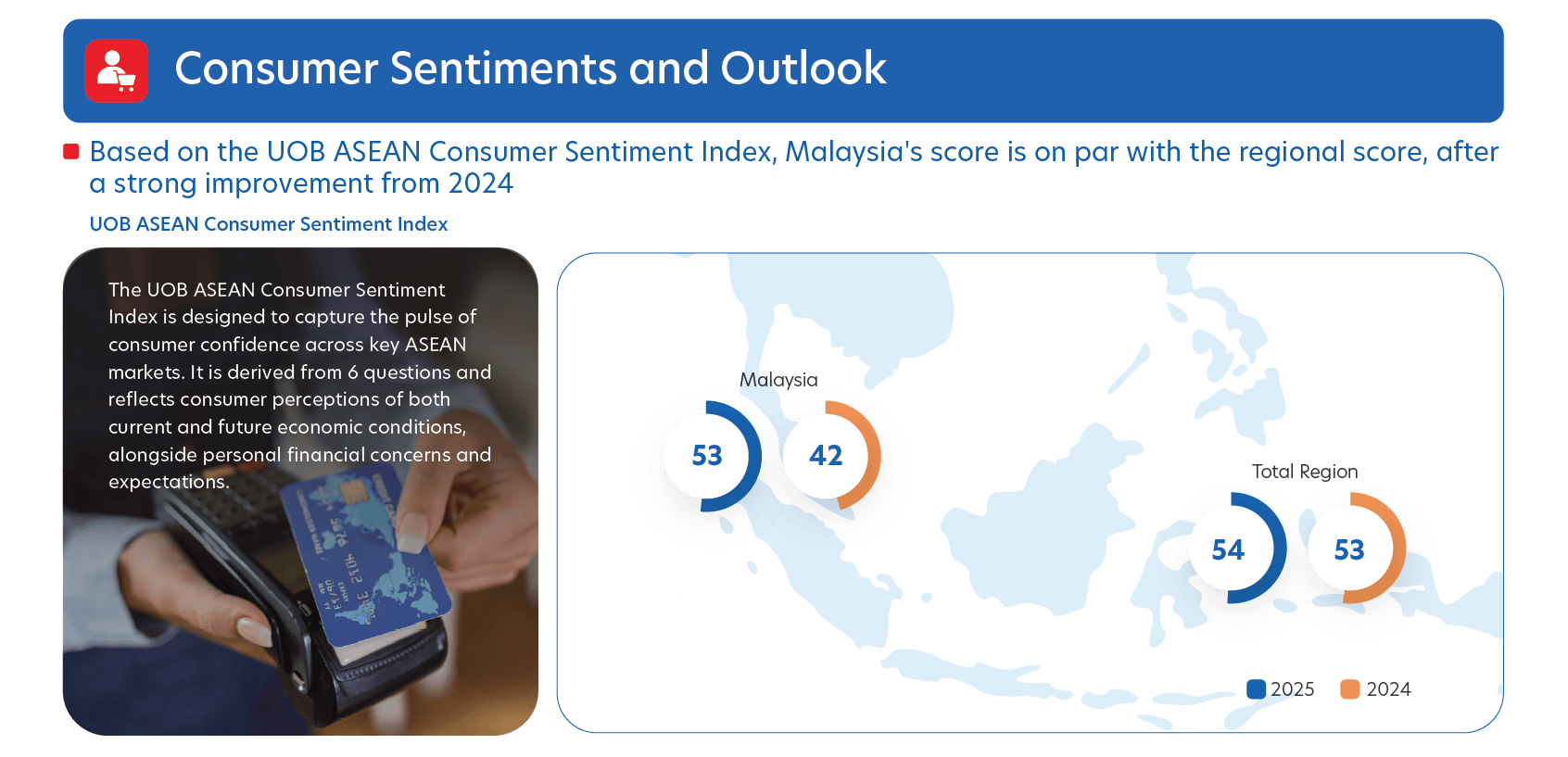
Malaysia presents a complex portrait, with a more nuanced picture under the numbers. Local consumer confidence has improved in 2025, albeit from a low base. The country’s Consumer Sentiment Score is up 11 points from 42 in 2024, the biggest improvement in ASEAN. It is slightly behind Indonesia, which has a Sentiment Score of 55, and trails behind regional leader Vietnam (Sentiment Score = 67).
Consumers may just be following the lead of Malaysia’s business leaders, who generally express confidence about the current economic environment. Many foresee strong growth despite economic headwinds, and Malaysia’s Ministry of Finance projects GDP growth of 4.0–4.5 per cent in 2026. Inflation is projected to remain low (1.3–2.0 per cent), unemployment is stable at 3.0 per cent, and wages are supported by progressive wage policies and skills upgrading. This stable macro environment is supportive of household spending, though external trade headwinds and subsidy rationalisation may create pockets of caution.

Figure 1: Malaysia’s Consumer Sentiment Score showed the biggest improvement within ASEAN, improving by 11 points from 2024
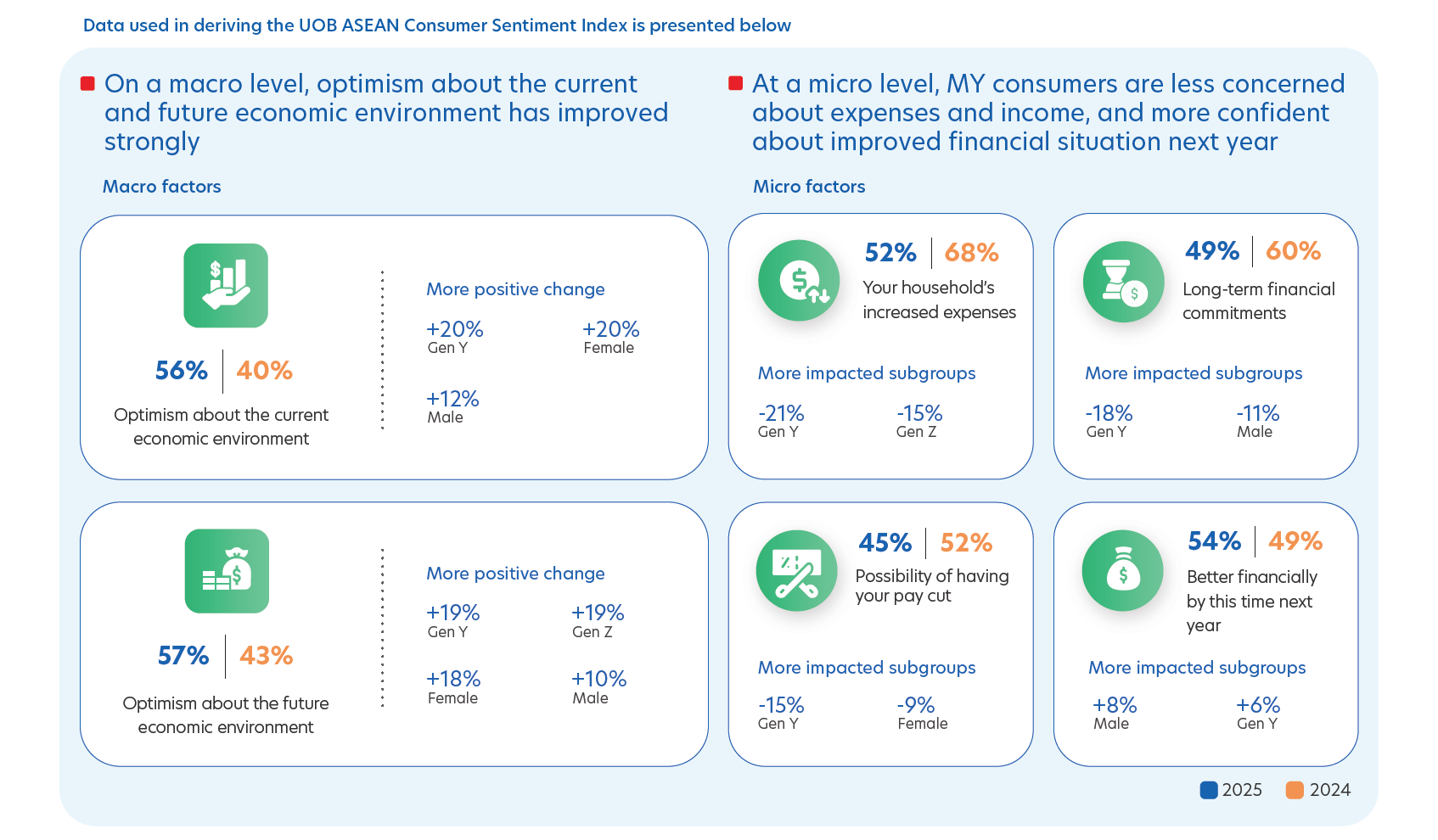
alaysians’ optimism about the economy has trickled down to personal finances, with fewer Malaysians now feeling anxious about their daily expenses. In 2025, a little more than half (52 per cent) of Malaysians report feeling anxious about increased household expenses. This is down 16 percentage points from the year before, the highest recorded change in the region.
Likewise, fewer Malaysians are worried about a decline in savings or wealth. The share of those reporting they are “very worried” or “somewhat worried” about this issue also dropped 15 points to 48 per cent, or slightly less than half of those surveyed. However, finances remain top of mind for most Malaysians, with 76 per cent reporting that it is a concern. The worry may be down to the increased cost of living due to inflation, an issue experienced across most of the region.
Among regional peers, Malaysians are the ones who are most concerned about their ability to afford essential items, with 32 per cent reporting this as a concern (vs 28 per cent regionally). While these concerns decreased slightly from 2024's peaks, they remain elevated compared with more confident markets like Vietnam.
Despite having a rosier outlook than the year before, Malaysians were still making conscious purchasing decisions in 2025. The share of those curbing spending has gone down year-on-year, yet the numbers are still higher than regional averages. Around half implemented cost-cutting strategies during shopping. Of those surveyed, 51 per cent reported spending less on non-essentials. Moreover, 47 per cent looked for offers or discounts when shopping.
Impulse buying has taken a back seat for many Malaysians. About 43 per cent reported taking more time to decide on new purchases—5 percentage points higher than the regional average. Moreover, 43 per cent think that it is neither a good time nor a bad time to make major purchases, indicating a wait-and-see approach rather than confident decision-making. Conscious budgeting also seems to be taking hold; 42 per cent have started tracking their expenses more carefully.
What does this cautious outlook suggest? Malaysians may be experiencing positive economic conditions at home while still being wary of economic risks from overseas. For instance, over half (53 per cent) are worried about US tariffs affecting them directly.

Figure 2: Top concerns of Malaysian consumers
Malaysians appear to be more concerned about their current or immediate needs over their longer-term plans. Malaysia has the second-lowest savings rate in ASEAN, with 5 per cent not saving anything and 1 per cent spending more than they earn monthly. Only 68 per cent save more than 10 per cent of their monthly income – the smallest share in the region. These numbers may reflect growing constraints on household savings.
While 86 per cent report that they have emergency funds, this figure is down 5 percentage points from 2024. More than half say they have funds to cover more than three months of expenses (55 per cent, up 5 percentage points from 2024).

Figure 3: Malaysians appear to be lagging behind the region in terms of insurance coverage, particularly for personal health insurance and whole life insurance
Malaysia also has the highest proportion of uninsured residents at 12 per cent, or double that of last year’s rate. Basic health insurance coverage is at 41 per cent, also the lowest rate in the region. This reflects a significant drop in protection – Malaysians appear to be cutting ‘optional’ coverage to manage cash flow, leaving themselves more vulnerable to personal risks.
It’s not just savings and insurance coverage taking a hit. Malaysians also seem to be pulling back from investing – only 45 per cent invest more than 10 per cent of their income, which is again the lowest share in the region. This may be attributed to cash flow pressures forcing them to preserve liquidity rather than deploy capital.
Looking beyond their most productive years, only 69 per cent of Malaysians have at least a fair idea of what they need to retire comfortably – the second lowest in the region. Of those who don’t know what retirement entails, 35 per cent cite not having enough income to save. This reinforces cash flow pressures limiting preparation.
Interestingly, while the minimum retirement age in Malaysia is 60 years old, 37 per cent expect to retire in their 50s, the second-highest share in ASEAN. Despite not having a fair idea of what a comfortable retirement might require, 87 per cent believe they will retain or improve their lifestyle in retirement.

Figure 4: More than 90 per cent of the younger generation (Gen Z, Gen Y) expect to improve or retain their lifestyles after retirement
This rosy outlook also reflects near-term positivity; 83 per cent of surveyed Malaysians think they’ll be better off this time next year. This number is up 5 percentage points from 2024.
Malaysia's consumer sentiment appears to signal a market expecting to recover soon. Malaysian households may still be experiencing some purchasing power erosion, with rising living costs weighing heavier on household budgets. Cost-cutting strategies are being employed, though by a slightly smaller share of the population compared with a year ago. Moreover, many appear to be consuming their financial buffers to maintain current living standards, leaving themselves more vulnerable to future shocks.
The slight loosening of purse strings for short-term expenses belies a more upbeat economic outlook, with many seeing the future in a positive light.
Leverage UOB’s extensive ASEAN expertise to gain a deeper look into the trends shaping the Malaysian and broader ASEAN market, backed by research. Contact us to learn more.
For a deeper look into the trends shaping the Malaysian and broader ASEAN market, download the full report and infographics below.
The ASEAN Consumer Sentiment Study (ACSS) is UOB’s regional flagship study that analyses consumer trends and sentiment across five countries (Singapore, Malaysia, Thailand, Indonesia, and Vietnam).
Now in its sixth year, the 2025 survey was conducted in June and captures responses from 5,000 consumers — 1,000 from each country. At UOB, we help businesses navigate the dynamic landscape of the ASEAN region to unlock its full potential.
This article shall not be copied or relied upon by any person for whatever purpose. This article is given on a general basis without obligation and is strictly for information only. The information contained in this article is based on certain assumptions, information and conditions available as at the date of the article and may be subject to change at any time without notice. You should consult your own professional advisers about the issues discussed in this article. Nothing in this article constitutes accounting, legal, regulatory, tax or other advice. This article is not intended as an offer, recommendation, solicitation, or advice to purchase or sell any investment product, securities or instruments. Although reasonable care has been taken to ensure the accuracy and objectivity of the information contained in this article, UOB and its employees make no representation or warranty, whether express or implied, as to its accuracy, completeness and objectivity and accept no responsibility or liability for any error, inaccuracy, omission or any consequence or any loss or damage howsoever suffered by any person arising from any reliance on the views expressed and the information in this article.

Get the ACSS 2025 Malaysia infographics. Download now