You are now reading:
ASEAN Consumer Sentiment Study 2026 (Regional): How ASEAN consumers are rethinking wealth, spending and the future

Find out how we can help you fast-track your investments in the JS-SEZ.
Learn more
you are in UOB ASEAN Insights


You are now reading:
ASEAN Consumer Sentiment Study 2026 (Regional): How ASEAN consumers are rethinking wealth, spending and the future
What does being wealthy mean to consumers in ASEAN today?
For many, it is less about status and more about living without financial worry, looking after their family and staying healthy. This practical outlook runs through the 2026 UOB ASEAN Consumer Sentiment Study (ACSS).
Now in its seventh edition, the study surveyed 5,000 consumers aged 18 to 65 across Singapore, Malaysia, Thailand, Indonesia and Vietnam in June 2026. The findings show consumers balancing ambition with preparedness: adopting digital tools and AI, all while continuing to save, protect, and plan for the future.
Here are five trends shaping how ASEAN consumers think about money in 2026.
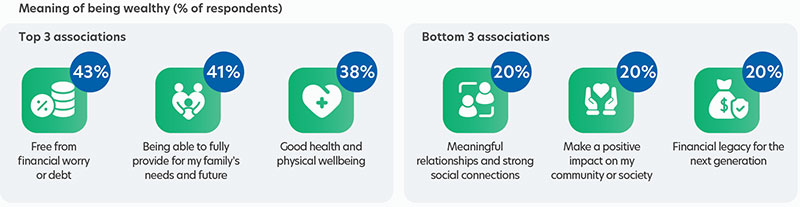
Across the region, 43 per cent associate being wealthy with freedom from financial worry or debt. Being able to fully provide for their family’s needs and future comes next at 41 per cent, while 38 percent point to good health and physical wellbeing.
Yet, building wealth also comes with added pressure. The high cost of living is the most common obstacle at 38 per cent, followed by economic uncertainty at 35 per cent and unexpected expenses at 30 per cent.
Digital tools are helping more consumers understand their finances. Among users, 34 per cent use them to track income, spending or cash flow. A third use them to plan financial goals or adjust investments, while 33 per cent use them to buy, sell or adjust investments easily.
Trust remains central to the continued use of these digital tools. Strong security and privacy protection is the most important feature users look for in digital wealth management tools, cited by 38 per cent. Consumers also value easy-to-use platforms, real-time visibility and transparent portfolio performance and fees.
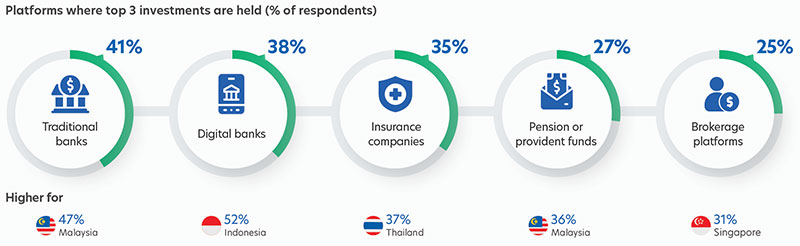
Despite the increased use of digital tools, banks remain the top platform for investments. Traditional banks remain the most widely used platforms for consumers’ top three investments, at 41 per cent, followed by digital banks at 38 per cent. Human expertise continues to matter too, as consumers prefer relationship managers when they need help understanding complex products, making investment decisions or clarifying fees.
While digital tools have become a regular part of financial management, consumers continue to value professional advice for more complex decisions.
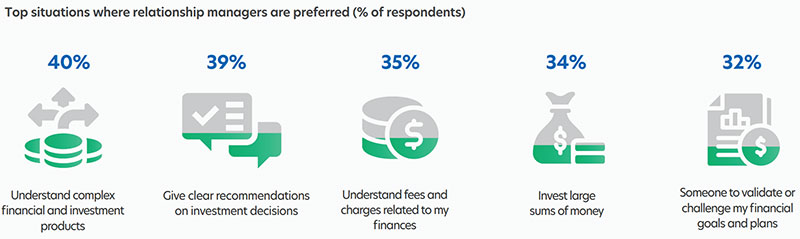
Roughly one in three consumers (32 per cent) currently work with a financial advisor, wealth manager or private banker, while another 35 per cent are open to or actively looking for one. Relationship managers are particularly valued when consumers need help understanding complex financial products (40 per cent), receiving investment recommendations (39 per cent) or clarifying fees and charges (35 per cent).
What distinguishes human advisors is not only expertise but the ability to provide personalised advice tailored to an individual's financial situation (35 per cent) and a level of trust and reassurance that digital tools cannot replace (34 per cent). These findings suggest that rather than choosing between digital and human support, consumers increasingly see both as complementary, using technology for everyday financial management while turning to trusted advisors for guidance on more significant decisions.
Across the region, AI is rapidly gaining trust, with 79 per cent of consumers using AI tools for financial activities at least once a week, and 62 per cent trusting AI-powered tools to act in their best financial interest.
AI is most often used to compare banking products, as cited by 39 per cent, and to understand financial information or documents, at 36 per cent. It is also used for budgeting, savings and investment decisions.
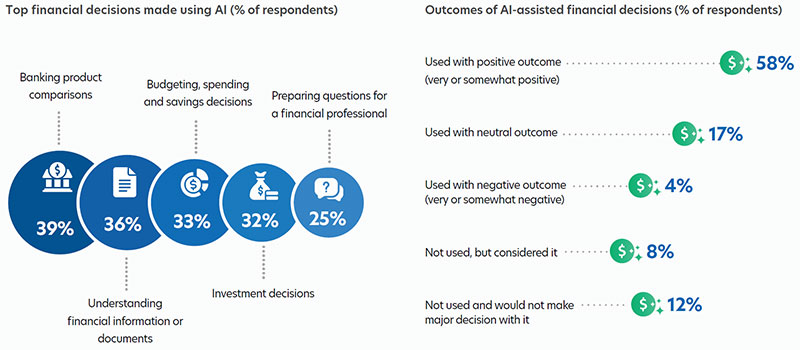
Positive experiences with AI-assisted financial decisions may be encouraging adoption. Of the consumers surveyed, 4 in 5 consumers (81%) have made a significant financial decision based primarily on AI advice. Among those who acted, nearly three-quarters (72%) reported a positive outcome, including 32% who reported a very positive outcome and 40% who reported a somewhat positive outcome, while only four per cent report a negative one.
Still, consumers place greater confidence elsewhere when it comes to acting in their best financial interest. Primary banks lead at 76 per cent, followed by peers, friends or family at 72 per cent and human financial advisors or wealth managers at 71 per cent. This suggests how AI-assisted financial guidance can complement trusted relationships rather than replace them.
Even as consumers explore new technology and cross-border opportunities, financial preparedness remains strong. Some 88 per cent feel confident about managing their personal finances effectively.
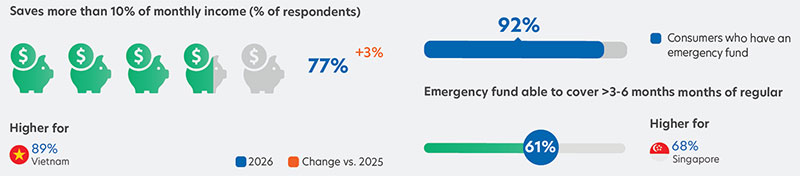
Saving remains a core habit, as more than three in four save over ten per cent of their monthly income, while 92 per cent have an emergency fund. Of the consumers surveyed, 61 per cent have emergency funds that can cover three to six months of regular expenses.
Protection is another priority, as more than three in four believe they have adequate insurance coverage for their current and future needs, with health and life insurance the most widely held types. Online channels remain the preferred way to buy insurance at 40 per cent.
Across the region, more consumers are also looking further ahead, with 58 per cent investing more than ten per cent of their annual income and 88 per cent actively seeking information to improve their investment knowledge. Nearly three in four believe they have a fair to good idea of how much they need for a comfortable retirement, while seven in ten have started legacy planning.
Taken together, these findings point to ASEAN consumers who are open to advisory, digitally enabled, and future-focused. Consumers are embracing wealth discussions and new technologies while continuing to prioritise security, trusted guidance and strong financial foundations.
For financial providers, the opportunity is not simply to offer more digital options, but to complement them with trusted advisory services that help consumers make sense of more choices, protect what matters and plan with confidence through different stages of life.
To explore these findings in greater detail, download the full UOB ASEAN Consumer Sentiment Study 2026 report and see how consumer priorities are evolving across Singapore, Malaysia, Thailand, Indonesia and Vietnam.
At UOB, we help businesses navigate the dynamic landscape of the ASEAN region to unlock their full potential. Contact us to find out about our tailored solutions, industry knowledge, and market expertise.

The ASEAN Consumer Sentiment Study (ACSS)is UOB’s flagship regional survey, tracking consumer trends and sentiment across five key markets: Singapore, Malaysia, Thailand, Indonesia and Vietnam. Now in its seventh year, the 2026 edition of the study was conducted in June and captures the views of 5,000 consumers, with 1,000 respondents from each country.
Key topics covered include:
This article shall not be copied or relied upon by any person for whatever purpose. This article is given on a general basis without obligation and is strictly for information only. The information contained in this article is based on certain assumptions, information and conditions available as at the date of the article and may be subject to change at any time without notice. You should consult your own professional advisers about the issues discussed in this article. Nothing in this article constitutes accounting, legal, regulatory, tax or other advice. This article is not intended as an offer, recommendation, solicitation, or advice to purchase or sell any investment product, securities or instruments. Although reasonable care has been taken to ensure the accuracy and objectivity of the information contained in this article, UOB and its employees make no representation or warranty, whether express or implied, as to its accuracy, completeness and objectivity and accept no responsibility or liability for any error, inaccuracy, omission or any consequence or any loss or damage howsoever suffered by any person arising from any reliance on the views expressed and the information in this article.



24 Jul 2026 • 3 mins read
Get the ACSS 2026 (Regional) infographics. Download now